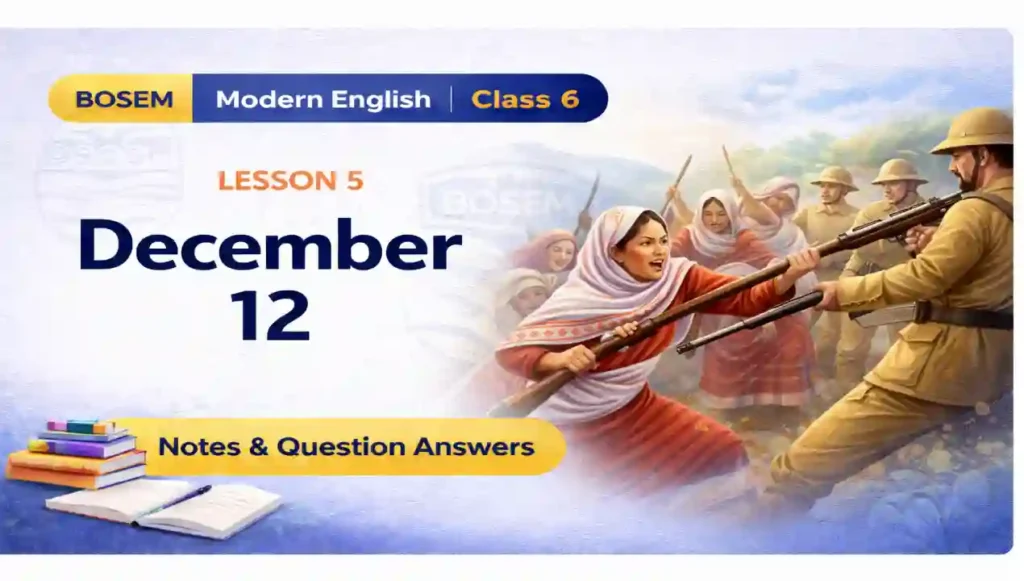
BOSEM Class 6 English Chapter 5, December 12, is a powerful poem written by Hijam Irabot Singh. The poem pays tribute to the courage, unity, and righteousness of the women of Manipur who took part in the historic Nupi Lan movement.
Table of Contents
Poem Summary- December 12
Hijam Irabot Singh was a poet, social reformer, and revolutionary. He wrote the poem on December 12 in his collection Emagi Puja, which contains 49 poems written while he was in jail in Sylhet, Bangladesh.
Manipur witnessed two Nupi Lan movements in its history. The first Nupi Lan took place in 1904 against forced labour. The second Nupi Lan occurred in December 1939 against the export of rice from Manipur when people were starving. This struggle led to the establishment of a better government in Manipur that was responsible and accountable to its people.
The poem December 12 was written to pay tribute to the women of Manipur for their courage, unity, and righteousness. Through this poem, the poet seeks to awaken the spirit of women and encourage them to continue fighting for a better society in Manipur.
The lines “The night has passed, Another day has gone” refer to the passing of time. The poet hints that though the glorious days of the Nupi Lan have passed, people must look forward and work for better days again.
In the lines “Devi, tuck and tie your hair hanging loose and dishevelled,” the poet calls upon the women of Manipur to unite and prepare themselves to fight again as they did during the Nupi Lan of December 1939.
The poem reminds us that December 12, 1939, will remain an important day in Manipur’s history. It represents the courage, unity, and determination of the women of Manipur. The poet asks whether we have forgotten that great day and encourages women not to stop fighting for a better tomorrow.
BOSEM Class 6 English Chapter 5 Question Answers
Q1. What does the poet mean by December 12?
Answer: By December 12, the poet means the Nupi Lan.
Q2.Who is the Devi the poet has referred to?
Answer: The Devi refers to the women of Manipur, known for their remarkable courage.
II. What does the poet mean by the following lines:
“The night has passed,
Another day has gone.”
Answer: These lines are taken from the poem “December 12.” They refer to the passing of time. The Nupi Lan brought changes, and the worst days of atrocities had passed. The poet hinted at the need to look forward to better days.
“Devi, tuck and tie your hair
Hanging loose and dishevelled.”
Answer: These lines are taken from the poem “December 12.” The poet told the women of Manipur to gather their unity and prepare themselves to fight again like they did in the Nupi Lan.
“One December Twelve’s gone and
Another December Twelve’s come.”
Answer: These lines are taken from the poem “December 12.” As years pass by, many December 12 days come and go. This reminds us of the Nupi Lan of December 12, 1939, and the courage and unity of Manipuri women.
“Did you believe hair’ll be tucked and tied?
Did you really think the day’ll come again?”
Answer: These lines are taken from the poem “December 12.” By asking these questions, the poet praised the courage of Manipuri women who fought for society. He also questioned whether such courage and unity would return.
III. Why does the poet think that the day will come again?
Answer: The poet believed that Manipuri women, with their great courage and unity, would come forward again in the future to fight for changes in society.
Additional Important Questions and Answers
Q1. Who wrote the poem “December 12”?
Answer: The poem “December 12” was written by Hijam Irabot Singh.
Q2. What is the main theme of the poem “December 12”?
Answer: The main theme of the poem is courage, unity, and the spirit of struggle of the women of Manipur.
Q3. What historical event does the poem “December 12” refer to?
Answer: The poem refers to the Second Nupi Lan of December 1939, which was a women’s movement against British rule and the export of rice from Manipur.
Q4. Why did the women of Manipur protest in December 1939?
Answer: The women protested against the export of rice from Manipur at a time when people were starving.
Q5. What does the poet want the women of Manipur to remember?
Answer: The poet wants them to remember the courage, unity, and righteousness shown during the Nupi Lan.
Q6. What does “tuck and tie your hair” symbolise in the poem? Answer: It symbolises preparation, unity, and readiness to fight for justice.
Q7. How does the poet encourage the women through this poem?
Answer: The poet encourages the women by reminding them of their past bravery and urging them to continue fighting for a better society.
Q8. Why is December 12 considered an important day in Manipur’s history?
Answer: December 12 is important because it marks the historic Nupi Lan movement, which demonstrated the courage and unity of Manipuri women.
Q9. What values does this poem teach students?
Answer: The poem teaches values such as courage, unity, patriotism, and social responsibility.
Q10. Why does the poet believe that such a day will come again?
Answer: The poet believes that the spirit of courage and unity among Manipuri women will rise again, bringing positive change to society.
Difficult Words Meaning
Difficult Words & Meanings
- Tributean act of showing respect or praise
- Righteousnessmoral goodness and fairness
- Unitybeing together as one
- Couragebravery in facing danger
- Atrocitiescruel and violent acts
- Dishevelleduntidy and messy
- Gatherto bring together
- Hinta slight suggestion
- Encourageto give support or confidence
- Reformto improve by making changes
- Revolutionarya person who fights for major change
- Colonialrelating to rule by another country
- Exportto send goods to another country
- Accountableresponsible for actions
- Spherearea of activity or influence
- Essencethe most important quality
- Strugglea hard fight or effort
- Liberationfreedom from control
- Oppressionunfair and cruel treatment
- Mobiliseto organise people for action
- Pass awayto die
- Generationall people born around the same time
- Coloniserspeople who settle and rule foreign land
- Awakento make aware or active again
- Shrewdnessclever understanding and good judgment
❓FAQs
Where can I find BOSEM Class 6 English Chapter 5 question answers?
You can find accurate BOSEM Class 6 English Chapter 5 question answers here, including a summary, an explanation of the poem “December 12,” additional important questions, vocabulary, and word meanings.
What is the summary of BOSEM Class 6 English Chapter 5 “December 12”?
The poem “December 12” highlights the courage and unity of the women of Manipur during the historic Nupi Lan of 1939 and encourages them to continue fighting for a better society.
What does December 12 mean in the BOSEM Class 6 English Chapter 5?
In BOSEM Class 6 English Chapter 5, December 12 refers to the Second Nupi Lan movement of 1939, when the women of Manipur protested against injustice and oppression.
Why is BOSEM Class 6 English Chapter 5 important for exams?
BOSEM Class 6 English Chapter 5 is important for exams because it includes poem explanation, line-by-line meanings, and short and long answer questions based on the Nupi Lan movement.