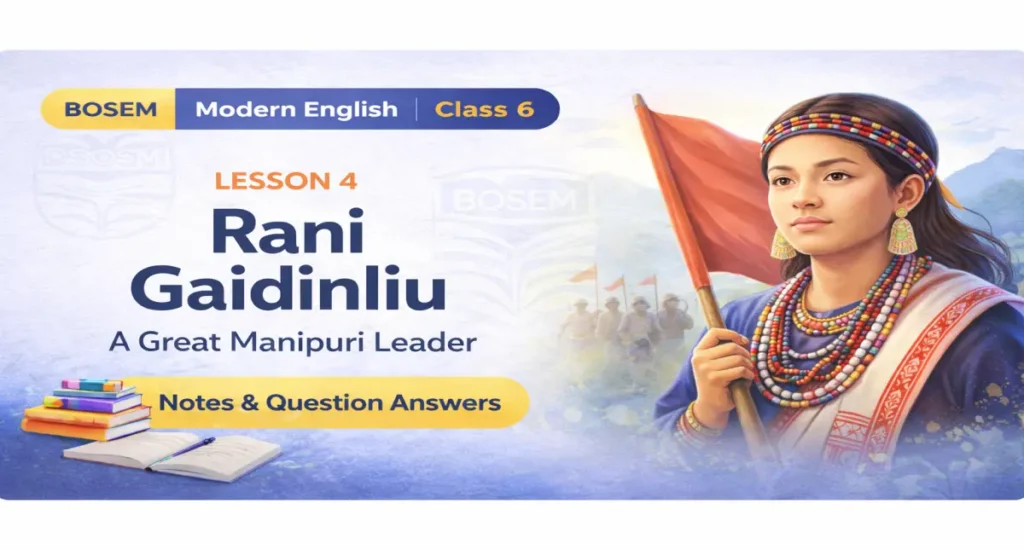
BOSEM Class 6 English Chapter 4, Rani Gaidinliu – A Great Manipuri Leader, highlights the courage, determination and leadership of one of Manipur’s most respected freedom fighters. This lesson is important for examination as it teaches patriotism, sacrifice and resistance against colonial rule.
Table of Contents
Chapter 4 Summary
Rani Gaidinliu – A Great Manipuri Leader
Rani Gaidinliu was one of the great leaders who struggled against British colonial rule. She was born on 26 January 1915 in the village of Nungkao, in the scenic Tamenglong hills of Manipur. From her early days, she showed strong willpower, independent thinking, and courage.
As a young girl, she was deeply aware of injustice in society. The exploitation under British colonial rule made her realise the need to fight against oppression. She joined the movement led by Haipou Jadonang at the age of thirteen. After Jadonang was hanged in 1931, she became the leader of the Zeliangrong movement, which aimed at freeing her people from British rule and integrating them.
She actively organised resistance against the British from 1931 to 1932. Due to her armed struggle, she was arrested in October 1932 and sentenced to life imprisonment. She was imprisoned in different jails, including Guwahati and Shillong. Jawaharlal Nehru admired her courage and gave her the title “Rani” in 1937.
She was released after fourteen years of imprisonment. She returned to Manipur in 1951. Rani Gaidinliu passed away on 17 February 1993. She is remembered for her bravery, sacrifice, and dedication to her people.
BOSEM Class 6 English Chapter 4 Question Answers
I. Answer the following questions in a sentence each:
Q1. Whom are we proud of?
Answer: We are proud of all the great leaders who were born in Manipur.
Q2. What have our leaders shown?
Answer: Our leaders have shown remarkable courage in their sufferings and sacrifices for Manipur.
Q3. Who influenced Rani Gaidinliu?
Answer: Rani Gaidinliu was influenced by Haipou Jadonang.
Q4. Where was Gaidinliu born?
Answer: Gaidinliu was born in a village called Nungkao situated in the Tamenglong hills of Manipur.
Q5. What was the aim of the Zeliangrong movement?
Answer: The Zeliangrong movement aimed at liberating the people of Manipur from British colonial rule.
Q6. Who was the Manipuri leader who urged for her release?
Answer: The Manipuri leader who urged for her release was Hijam Irabot.
Q7. Who gave the title ‘Rani’ to Gaidinliu?
Answer: Jawaharlal Nehru gave her the title ‘Rani’.
II. Answer the following questions in about 20–25 words each
Q1.How did Rani Gaidinliu grow up as a fearless girl?
Answer: Rani Gaidinliu grew up as a fearless girl. She had very strong willpower. She was also sincere, determined, and very independent in her thinking and actions.
Q2. Give reasons why she decided to fight the British.
Answer: Gaidinliu observed the injustice in society and the British exploitation and oppression of the Manipuri people. Undaunted, she decided to fight them.
Q3. What did Gaidinliu do between 1931 and 1932?
Answer: Gaidinliu organised her people and led an armed struggle against the British. She was actively involved in the rebellion from 1931 to 1932 until she was arrested.
Q4. What was her attitude to her culture and religion?
Answer: Gaidinliu firmly believed in her culture and religion. She was proud of her culture and wanted to protect the identity of the Zeliangrong people.
Q5. Write about her life in prison.
Answer: While staying in Guwahati Jail, Gaidinliu protested against the inhospitable conditions. She was later transported to Shillong Jail and was released after fourteen years of imprisonment.
III. Answer the following questions in about 50–60 words each
i. Give an account of Rani Gaidinliu’s struggle against the British.
Answer: Rani Gaidinliu joined the Zeliangrong movement led by Haipou Jadonang at a very young age of thirteen. She mobilised the people to fight against British colonial rule in India. She also led an armed struggle against the British from 1931 to 1932 until she was arrested. At Guwahati Jail, she protested the inhospitable conditions and was later transferred to Shillong Jail.
ii. Write a note on Gaidinliu’s ideas.
Answer: Gaidinliu was fearless, sincere, and determined with strong willpower. She stood against injustice and struggled for the liberation of the Manipuri people. Her ideas influenced many people and mobilised them against British colonisers. She was protective of her culture, religion, and the identity of the Zeliangrong people. She became a legendary figure.
Additional Important Questions and Answers
BOSEM Class 6 English Chapter 4, Rani Gaidinliu – A Great Manipuri Leader
Q1. When was Rani Gaidinliu born?
Answer: Rani Gaidinliu was born on 26 January 1915.
Q2. At what age did Gaidinliu join the Zeliangrong movement?
Answer: Gaidinliu joined the Zeliangrong movement at the young age of thirteen.
Q3. Why did the British authorities fear Gaidinliu?
Answer: The British authorities feared Gaidinliu because she organised people and led a strong resistance movement against British colonial rule.
Q4. What qualities made Gaidinliu a strong leader?
Answer: Her courage, determination, independence in thinking, sincerity, and strong will-power made her a strong leader.
Q5. What happened to Gaidinliu after her arrest?
Answer: After her arrest, Gaidinliu was sentenced to life imprisonment and sent to different prisons, including Guwahati and Shillong.
Q7. How long was Rani Gaidinliu imprisoned?
Answer: Rani Gaidinliu was imprisoned for fourteen years.
Q8. Why is Rani Gaidinliu remembered in Manipur?
Answer: Rani Gaidinliu is remembered for her courage, sacrifice, and struggle against British colonial rule.
Q9. What does this lesson teach students about leadership?
Answer: This lesson teaches students that true leadership requires courage, sacrifice, determination, and dedication to one’s people.
Q10. How did Gaidinliu protect her culture?
Answer: Gaidinliu firmly believed in her culture and religion and wanted to protect the identity of the Zeliangrong people.
Q11. Why is Rani Gaidinliu considered a legendary figure?
Answer: She is considered a legendary figure because of her fearless resistance against British rule and her lifelong dedication to her people.
Difficult Words & Meanings
- Colonialrelating to rule by a foreign country
- Colonialismcontrol of one country by another
- Oppressioncruel and unjust treatment
- Exploitationunfair use of people for benefit
- Resistanceopposition against authority
- Movementorganised effort for a cause
- Liberationact of setting free
- Integrationbringing together into unity
- Revoltrising against authority
- Mobiliseorganise people for action
- Rebellionopen resistance against rulers
- Armed Strugglefight using weapons
- Authoritiespeople in power
- Arrestedtaken into custody by law
- Imprisonmentbeing kept in jail
- Inhospitableharsh and unfriendly conditions
- Transportedsent from one place to another
- Legendaryvery famous and admired
- Remarkableworthy of attention
- Independentthinking and acting freely
- Determinedfirm in decision
- Sincerehonest and genuine
- Will-powerstrong control over mind
- Liberateto set free
- Suppressto stop by force
- Revolutionaryperson who fights for change
- Coloniserspeople who settle and rule foreign land
- Identitydistinct character of a group
- Sacrificegiving up something for a cause
- Admireto respect deeply
- Sentencedgiven punishment by court
- Campaignorganised series of actions
- Concernworry or anxiety
- Convertto change religion or belief
- Protestedexpressed strong objection
- Isolatedkept away from others
Vocabulary
Answers:
1. Rani Gaidinliu was born in Manipur.
2. Manipuris are proud of Rani Gaidinliu.
3. She was a woman full of courage.
4. Gaidinliu was determined to drive the British away from Manipur.
5. The British exploited the people of Manipur.
6. Gaidinliu mobilised the people to fight against the British colonisers.
7. The Zeliangrong movement fought for liberation of the people.
8. It was a struggle against British colonial rule.
9. Gaidinliu was imprisoned by the British.
10. The great revolutionary leader Hijam Irabot pressed for her release.
11. She wanted to protect the identity of the Zeliangrong people.
❓FAQs
Where can I find BOSEM Class 6 English Chapter 4 question answers?
You can find accurate BOSEM Class 6 English Chapter 4 question answers here, including short answers, long answers, summary, vocabulary, and important additional questions from the lesson Rani Gaidinliu – A Great Manipuri Leader.
What is the summary of BOSEM Class 6 English Chapter 4?
The summary of BOSEM Class 6 English Chapter 4 highlights Rani Gaidinliu’s life, courage, and struggle against British colonial rule, as well as her leadership in the Zeliangrong movement.
Who was Rani Gaidinliu in BOSEM Class 6 English Chapter 4?
In BOSEM Class 6 English Chapter 4, Rani Gaidinliu is described as a fearless Manipuri leader who fought bravely against British oppression and protected her culture and people.
Why is BOSEM Class 6 English Chapter 4 important for exams?
BOSEM Class 6 English Chapter 4 is important for exams because it teaches patriotism, courage, and leadership, and includes important short and long answer questions.